art history
Daybreak by Maxfield Parrish: the painting, the models and the print
Two figures, a stone terrace and the first light of morning: the story of Parrish's best-known painting, and what is fact and what is legend.

Daybreak is the painting most people picture when they hear the name Maxfield Parrish. Painted in 1922, it shows two figures under a stone portico at the first light of morning, with a lake and blue hills behind them. Sold as an art print from the following year, it hung in homes across America, and in 2006 the original set the auction record for the artist. This is the story of the picture: who posed for it, how Parrish built it, how it became a print, and what is documented and what is legend.
Daybreak at a glance
| Artist | Maxfield Parrish (1870–1966) |
|---|---|
| Painted | 1922, at The Oaks, his home and studio in Plainfield, New Hampshire |
| Size | 67.3 × 114 cm (26.5 × 45 in) |
| Medium | Oil on board, built up in transparent glazes |
| Print publisher | The House of Art, New York, from 1923 |
| Auction record | About 7.6 million dollars, Christie's, May 2006 |
What the painting shows
The scene is calm and almost still. A young woman lies on the stone floor of a terrace between two columns. A girl bends over her, as if waking her. Behind them the ground falls away to water, a band of distant hills and a sky that moves from pale gold at the horizon to deep blue overhead. Columns and urns frame the view.
Nothing dramatic happens, and that is the point. Daybreak is about a single moment of light: the minute when the sun has not yet risen but the air already glows. Parrish called it his "great painting", and it gathers everything he had learned in thirty years of illustration: classical architecture, idealised figures, a landscape drawn from the New Hampshire hills, and above all the blue that became his signature.
Who posed for Daybreak
Parrish worked from photographs of his models, and the sources agree on two of them.
- Kitty Owen, a granddaughter of the politician William Jennings Bryan, posed for the reclining figure. A cut-out of that figure, which Parrish used while composing, is held by the Haggin Museum in Stockton, California.
- Jean Parrish, the artist's daughter, then about eleven years old, posed for the standing girl who leans over her.
A third name appears in some accounts: Susan Lewin, Parrish's model and companion for decades, who posed for many of his paintings. One version has Parrish using her figure for the reclining woman and giving it Kitty Owen's face. The sources do not settle this, so it is fair to say Kitty Owen and Jean are certain and Susan Lewin's part is possible.
How Parrish built the picture
A composition planned with geometry
Daybreak was laid out with great care. Several accounts say Parrish followed dynamic symmetry, a system of proportion based on rectangles and diagonals that the American artist Jay Hambidge was promoting in the early 1920s. The columns, the line of the hills and the placement of the two figures sit on that framework, which is one reason the picture feels so settled.
Photographs and cut-outs
Parrish photographed his models in poses he had planned, then cut out the figures so he could try them in the composition before painting. The Haggin Museum's cut-out of the reclining woman is a rare surviving piece of that process.
Colour in thin layers
Parrish did not paint Daybreak in one go. He laid a white ground, painted the scene first in blue, then built the colour in many thin, transparent glazes, sealing each with varnish before adding the next. Light passes through those layers to the white ground and back, which is why the sky in Daybreak seems lit from within. This method is the heart of what people call Parrish blue; we explain it step by step in What is Parrish blue?.
From painting to the best-known print of its time
Daybreak was made to be reproduced. Its publisher, the House of Art in New York, had already sold popular prints of Parrish's earlier pictures, and it issued Daybreak as a large colour print from 1923. The print was a success on a scale few paintings have ever had. It is often called the most popular art print of the twentieth century.
Two claims travel with it from site to site: that a copy hung in one in four American homes, and that it outsold every other print of its era. They may be close to the truth, but none of the accounts that repeat them names a source for the figures. What is documented is that the print stayed in production for years, that original House of Art copies in period frames still change hands among collectors, and that the image has never stopped being reproduced since.
The sales of the original
For most of the twentieth century the painting stayed in private hands. Christie's records Kitty Owen, by then Kitty Owen Spence, the model for the reclining figure, as an owner of the painting until 1974.
- May 2006: Daybreak sold at Christie's in New York for about 7.6 million dollars (7,632,000 with fees). Christie's later described it as the world auction record for the artist.
- May 2010: it sold again, for about 5.2 million dollars.
The painting remains in a private collection, so it is rarely on public view.
Why Daybreak still works on a wall
A hundred years on, the picture keeps its pull for the same reasons it sold in 1923. The composition is quiet and symmetrical, so it settles a room rather than filling it with noise. The palette is narrow, blue and gold with soft stone tones, which sits easily with most interiors. And the subject is universal: morning, calm, the light before the day begins.
Daybreak is a wide picture, about one and a half times wider than it is tall, so it reads best over a long stretch of wall, and so do Parrish's wide landscapes. If you are choosing a Parrish print, these points help:
- Measure the wall, not the room. Mark the size you are considering on the wall with masking tape and live with it for a day. It is the surest way to judge.
- Hang it at gallery height. Galleries hang a piece with its centre about 145 cm (57 in) from the floor.
- Choose the format for the room. A framed poster behind UV-protective acrylic suits a sunny room; a canvas gives the sky a soft texture; a poster lets you choose your own frame. All three are compared on The prints.
Questions about Daybreak
When did Maxfield Parrish paint Daybreak?
In 1922, at his studio in Plainfield, New Hampshire. The print was published by the House of Art in New York from 1923.
How big is the original Daybreak painting?
About 67.3 × 114 cm, or 26.5 × 45 inches.
Who are the two figures in Daybreak?
Kitty Owen, granddaughter of William Jennings Bryan, posed for the reclining woman, and Parrish's daughter Jean for the standing girl. Some accounts add his longtime model Susan Lewin.
Where is the original Daybreak now?
In a private collection. It sold at Christie's in 2006 for about 7.6 million dollars and again in 2010 for about 5.2 million.
Is Daybreak Parrish's most famous work?
Yes. It is his best-known painting and was the most successful print of his career. His mural Old King Cole, at the St. Regis hotel in New York, and the Edison Mazda calendar paintings such as Ecstasy are the other works most people know.
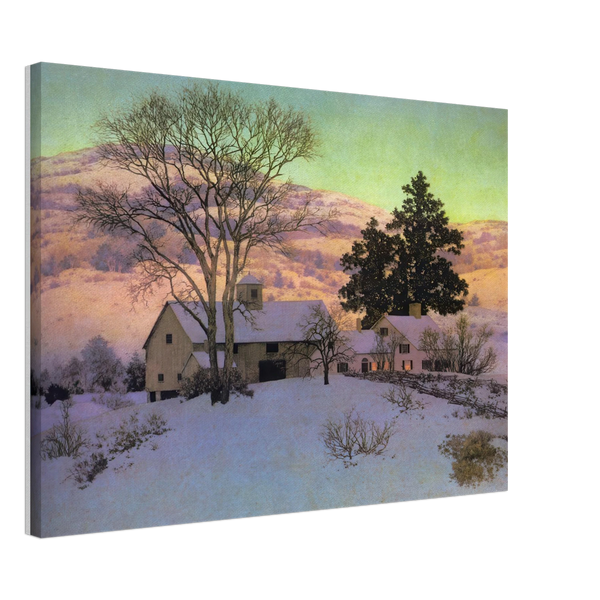
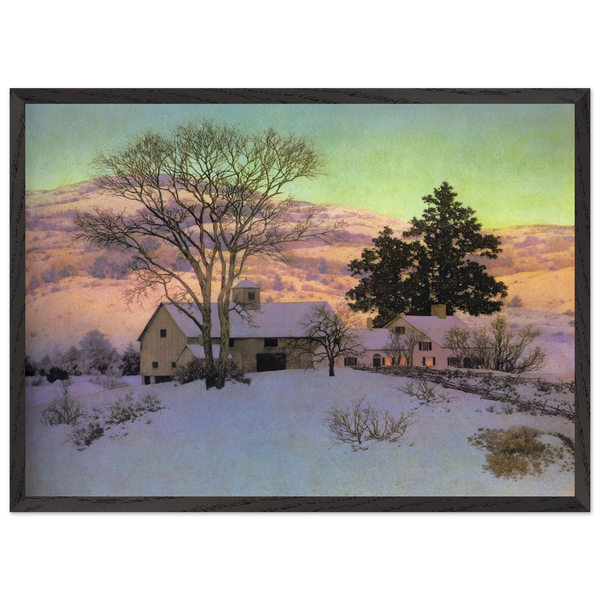
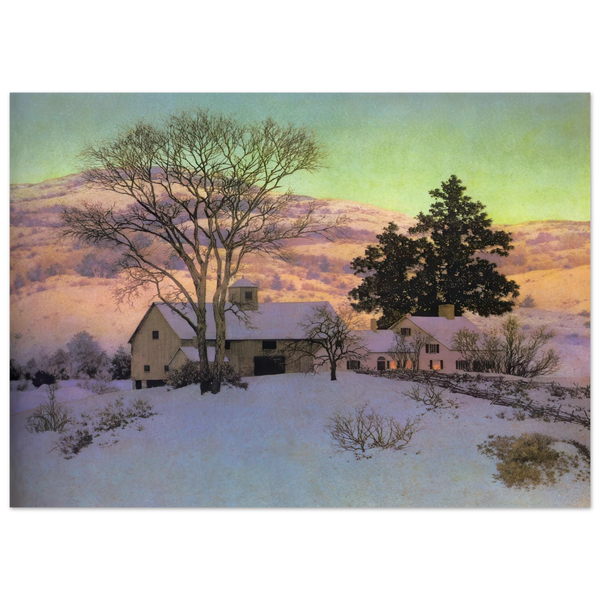
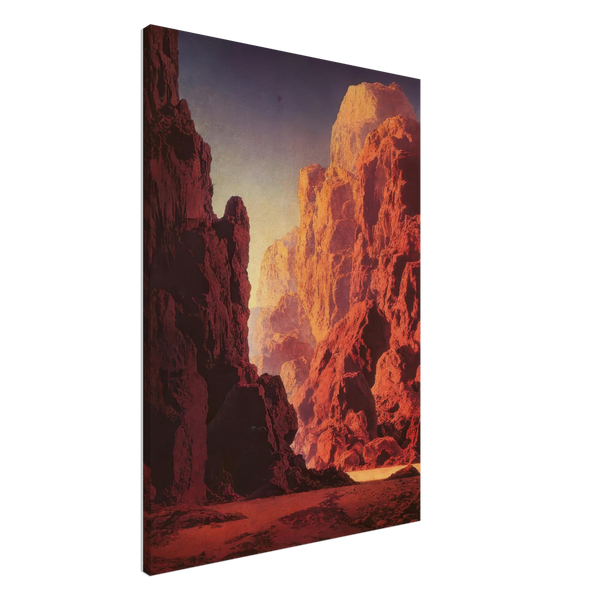
Parrish's light, made for your wall. The original Daybreak is in a private collection. Our collection gathers the landscapes, winter evenings and night skies of Parrish's later years, painted with the same glazes and the same blue, each as a poster, a canvas or a framed poster, in 50 × 70, 60 × 90 or 70 × 100 cm, made for your order and delivered free to 37 countries. See the dawn and morning light, or browse the whole collection.